
Desktop Tablet Phone
 Printable page in A4 size
 Lesson Three in Eight 15 Minute Topics.

1/ The Ageing Process
What is Normal Ageing?
It should probably mean "normal for you". Often we think of it as "normal for people of my age."
Good News: The idea the "normal health" being average health, needs to be opposed. The health of the general population is much poorer than desirable, and could be improved, if people have better knowledge.
What we are looking for is excellent health. How should I be, at my age, if I was really healthy?
If you were really healthy, you would sleep well, you would have enthusiasm for doing things, you would enjoy eating and being with friends. You wouldn't dread climbing stairs, or having to run after a ball. If you were healthy, you wouldn't have an excess weight problem.
Nutrition and Health
Everybody knows how to be healthy! So why isn't everyone healthy?. Maybe because "fake news" isn't new.
These graphs illustrate the problem with what everyone knows about nutrition and health.
The same principles are demonstrated by many alternative research efforts
Taking and active interest in your diet, sleep and exercise makes important differences to your health.
Take an Interest in Your Own Health
Click to Image to Enlarge
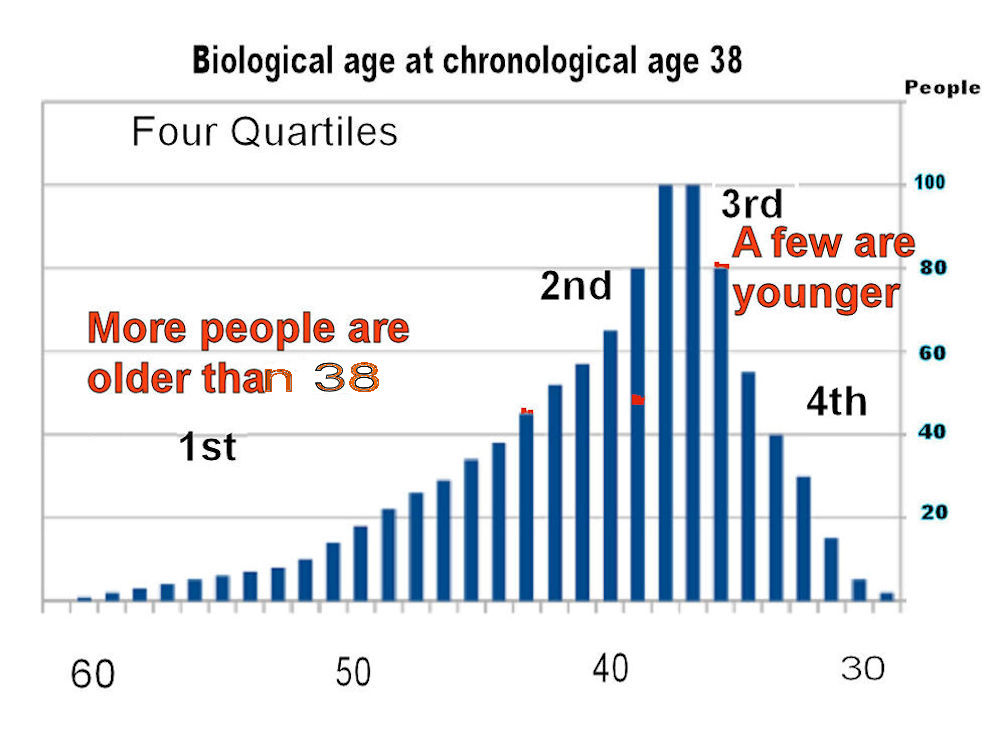
This image based on the Dunedin Study, has been horizontally flipped, so that poor health is on the left. People who are biologically older than 38.
On the right are a much smaller group who showed concern about their health, described by the researchers as "conscientious." You can't do anything to shift the curve, but you can certainly shift your position on the curve, once you recognise what the problem is.
Open Future Health argues that the recommended diet, has created a supermarket demand for processed foods that leaves you both hungry and lacking in nutrition. We eat more, because the poor quality of the diet leaves the body craving for proper food. Take and interest, and be active in living a healthy lifestyle.
Accelerated Bursts of Ageing
It's clear from research that we don't get older in a linear way. Rather we lose health in steps down from where we were. Dr Michael Snyder has tracked the health of only 109 people, over many years, with thousands of different markers, creating a massive data base for each person.
Dr Snyder has identified that there are two times when health declines for most people, in your early forties and in your early sixties. He doesn't say so, but this might be "midlife crisis" and "retirement" or "empty nest syndrome" in other words changes in how we see ourselves, and how our lifestyle changes.
Dr Michael Snyder on Ageing Spikes.
Dr Peter Attia writes about maintaining strength in your 40's into old age, so that you have a reserve of muscle, and aerobic capacity. When you do have a health reversal, and everyone does, after a step down, or several steps down, you have patterns of thinking, and behaviour, and reserves of strength to fully recover.
The Grant Study of Adult Development
Begun in 1938, the Grant Study of Adult Development charted the physical and emotional health of over 260 men, starting with their undergraduate days. The now-classic "Adaptation to Life" reported on the men's lives up to age 55 and helped us understand adult maturation. In his new book "Triumphs of Experience" George Vaillant follows the men into their nineties, documenting for the first time what it is like to flourish far beyond conventional retirement.
Long Life?
The denial of illness is an indicator of poor mental health. Few men who smoked or drank much alcohol survived past the age of 80. The deaths before the age of 55 were all because of events the individual could not control. Between 55 and 80 the causes of death were almost always things that the individual had much control over. If you choose not to be conscientious and to look after yourself, you can take many years off your life-span.
Better Health is Possible
There are higher rungs on the health ladder than we previously understood. To be more healthy, I don't need to go back to extreme exercise and marathon running. By careful attention to diet, moderate exercise, purposeful work, and active social engagement, we can live better lives, higher up the health ladder. Importantly, the higher rungs may not visible to you based on your present awareness!
What do you understand from this short lesson?
To search the Open Future Health website to find similar content. Choose 2 or 3 Keywords according to your interest.
Search multiple words like: "wordone+wordtwo+wordthree".
In Google, search multiple words like: "wordone+wordtwo+wordthree"
Alternatively ask Chat GP. Suggested prompt in natural language: "Briefly: I understand that (insert your own words here), is that a sensible view?"
Keep a brief record of what you have now understood.
Write a short note for yourself, in a document, or in a journal, so that you have a record of what you have understood.
Next Topic: Topic 2/ Your Personal Preventive Health Plan.

You can return to the Three Lessons Directory here. (Phone)
 Return to the Open Future Health Portal. (Where you started)