
Desktop Tablet Phone
 Printable page in A4 size
 Lesson Three in Twelve 15 Minute Topics.

3/ Insulin Resistance! - The Root of Metabolic Dysfunction?
Excess insulin in the bloodstream eventually leads to a negative reaction in some cells that close their insulin receptors, to "resist" the effect of insulin.
Insulin production is a response to foods that increase blood glucose, primarily sugars and starches, because excess glucose is itself toxic to the body. The pancreas normally manufactures enough insulin to force the USE of glucose, removing it from the bloodstream. That's a healthy process in most people.
Insulin's actions in the body:
1/ Insulin suppresses the breakdown of stored fat into free fatty acids in adipose (fat) tissue.
2/ Insulin promotes glycogen storage (glycogenesis) in muscle and liver.
3/ Insulin facilitates storage of surplus glucose as fat.
4/ Insulin has growth-promoting effects. It stimulates protein synthesis, inhibits protein breakdown, and supports the uptake of amino acids into cells.
Over time, excess glucose leads to a fatty liver, weight gain, and eventually type two diabetes.
We can stop excessive glucose spikes, by eating and drinking less sugar and starch.
The insulin resistance plague in our society is usually undiagnosed. You can't get fat, or get type two diabetes without insulin resistance. Insulin resistance is develops slowly in response to excess insulin over a long time, and it builds and builds over the years. If weight is an issue for you, insulin resistance is the topic you need to discuss with your doctor.
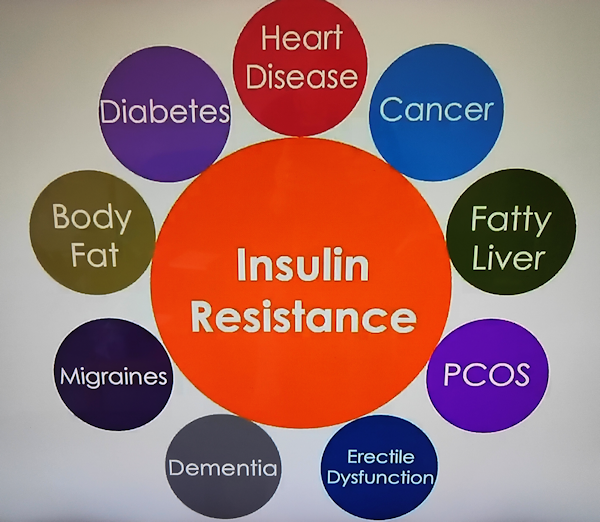
70% of all deaths today, are from chronic diseases, many of which were virtually unknown 100 years ago. These are modern lifestyle diseases all caused in the first instance by our poor nutrition, and secondly by our failure to exercise. It's easy to do something about that. Some of us will.
The people who suffered most from the Covid 19 pandemic were those with pre-existing health problems, most notably the diseases related to metabolic syndrome. Too often those problems like obesity and type II diabetes, have existed for many years. We now KNOW, that with lifestyle changes, people can lose weight and reverse their type II diabetes.
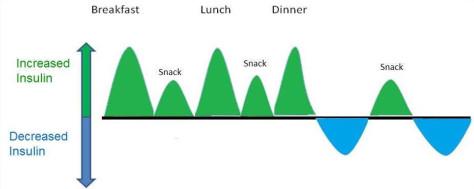
Constant eating keeps insulin "on" all day.
Mitochondria for Fat Oxidation
Most people don't understand where the energy of the body comes from. All of your cells have mitochondria that are continually converting glucose, fatty acids or ketones into ATP, the energy your cells use. (Krebs Cycle) You have less than 6 seconds supply of ATP in your body at any time, so this production process is continuous and under strict control.
High insulin forces glucose into your muscle cells, into muscle glycogen stores and into your fat cells. So long as the high glucose emergency lasts, insulin will also remain high. High insulin disables lipolysis, (The breakdown of fat for energy) and that means you cannot lose weight. Constantly high insulin starts a chain reaction that causes Metabolic Syndrome.
When your cells are already "full" but there is still excess blood glucose, EXTRA insulin is produced to FORCE the glucose in the blood down to normal levels. Over time that results in fatty liver disease, metabolic syndrome, and obesity. The long term health results are very varied, but they are all unpleasant and entirely avoidable.
Freedom from Chronic Illness
Typically, people who are 75 suffer from five or more "illnesses." That probably means almost all of them have metabolic syndrome.
It's not normal to suffer from pain, although that is a very common experience.
Metabolic syndrome is a set of five "diseases" that can all be corrected by dietary change. If you have metabolic syndrome, you are a prime candidate for later Alzheimer's disease. This is avoidable, if you look after your health.
What do you understand from this short lesson?
Search Site Open Future Health to find similar content. Choose 2 or 3 Keywords according to your interest.
If you want to search Google try here:
Alternatively ask Chat GP. Suggested prompt in natural language: "Briefly: I understand that (insert your own words here), is that a sensible view?"
Keep a brief record of what you have now understood.
Write a short note for yourself, in a document, or in a journal, so that you have a record of what you have understood.
Next Topic: Topic 4/ Your Self Image

You can return to the Three Lessons Directory here. (Tablet)
 Return to the Open Future Health Portal. (Where you started)