
Lesson Three in Eight 15 Minute Topics.

6/ Your Fitness Plan
Do Something to Improve Your Physical Fitness
You need to work hard, engaging as many muscle groups as possible.
There are four objectives here, increasing bone density, adapting your bones to carry more weight. Aerobic capacity, the ability of your lungs to pump a lot of air quickly. As you exercise blow out strongly to increase the amount of air you are processing. Increasing your heart rate, You should be able to double your resting heart rate, and maintain that for a short while at least. You may need to build up to that. Sustained exercise, you do not need to train for an hour at a time, but the sort of strength and fitness we are aiming at should allow us to dig the garden for an hour or more, or to walk up hills, or to climb several sets of stairs.
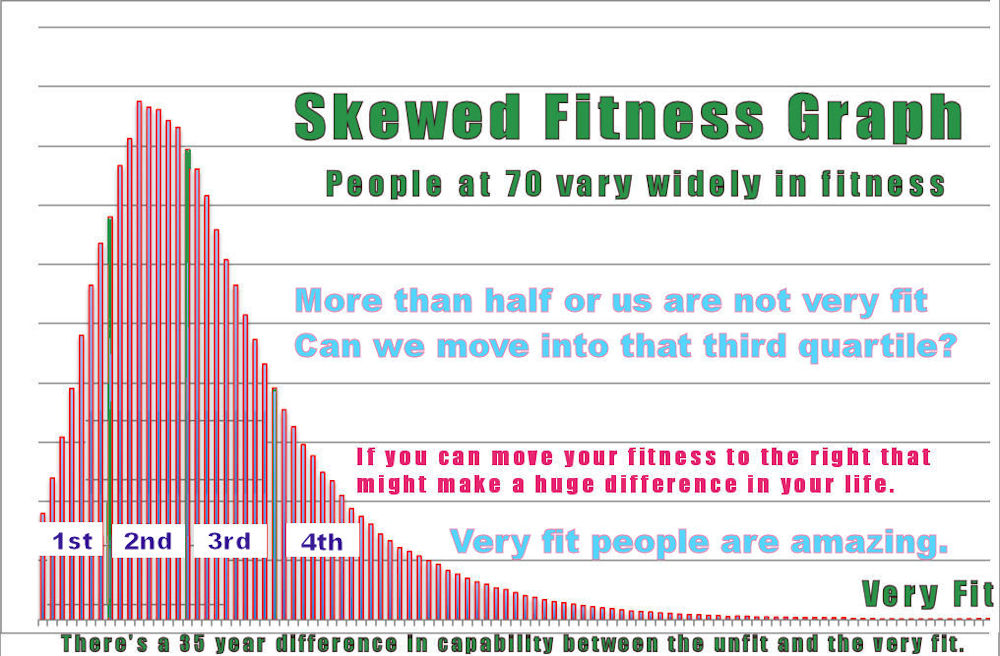
Click to Image to Enlarge
In this image poor health is also on the left. Too many of us let our muscular strength decline. We need to ask why? The old principle of calories in v calories out, and that people need to exercise more, doesn't stand up. They say; "You can't run away from a bad diet," and we believe that's clearly demonstrated in our community.
Once your diet is right and AFTER you have lost some excess weight, you will feel like exercise, and your are less likely to damage your joints in the process. Since most people do very little, it's not too hard to move YOURSELF along the above graph to the right. Club cyclists in London, a group where the average age was over 75, had the physical capability of the average man half their age. You can't get that with a 30 minute stroll around the block 3 times a week. You need to put in some effort.
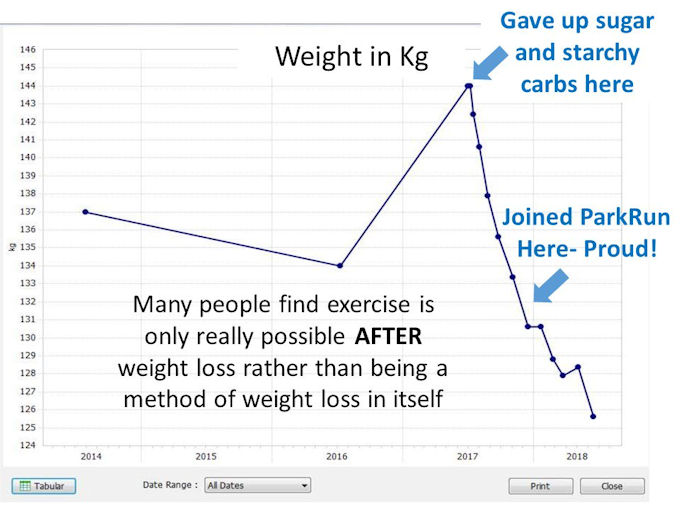
Weight Loss First - Then Begin to Exercise
Why the majority is always wrong
TEDx - Paul Rulkens
His work is based on his knowledge and experience about the practical application of behavioral psychology, neuroscience and especially common sense.
Mitochondria are energy conversion units.
Mitochondria are inside every cell in your body. If you exercise your cells produce more mitochondria to help with the process. The most effective exercise for that is easy to do and it's very quick. Exercise the muscle to failure with a suitable weight and a very slow continuous movement. It should take between 60 seconds and 90 seconds to reach failure (inability to continue) if the weight is right. Then don't do that again for 7 days, allow the muscle to recover fully. (See "Body by Science" by Dr Doug McGuff.)
Here are five exercises to do. You don't need to change your clothes or even break a sweat. You don't need any equipment except a bar to hang from or pull-up on.
The five exercises: Horizontal push (moving the door frame, or the car), and horizontal pull (rowing).
Vertical pull (pull-up on a bar) and vertical push (push-ups).
Finally a squat either a stationary squat with your hands pressing up against a table, or a moving squat with your hands holding weights.
Fitness for Work and Play

You should have energy to the ordinary things of life.
You should be able to walk long distances, and go up and down hills with ease.
You should be able to walk briskly. Can you stand upon one leg while putting a sock on the other?
When your walk slows, and especially when you begin to shuffle, your health is seriously impaired.
Exercise is important for your mind. Exercise increases the blood flow and 25% of that flows through the brain.
Exercise increases your strength and your confidence, and improves your quality of life.
An increasing number of falls is a bad sign. A serious fall resulting in a broken hip is often a signal of near term mortality. Keep dancing, it improves your strength and your balance.
Please choose a screen size to return to the Directory Homepage.